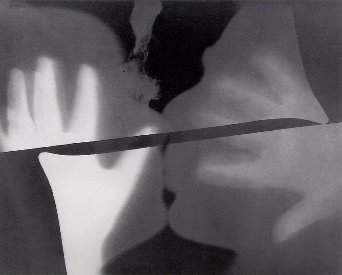
Man Ray, born Emmanuel Radnitzky (August 27, 1890 – November 18, 1976), was an American artist who spent most of his career in Paris, France. Perhaps best described simply as a modernist, he was a significant contributor to both the Dada and Surrealist movements, although his ties to each were informal. Best known in the art world for his avant-garde photography, Man Ray produced major works in a variety of media and considered himself a painter above all. He was also a renowned fashion and portrait photographer. He is noted for his photograms, which he renamed "rayographs" after himself.
While appreciation for Man Ray's work beyond his fashion and portrait photography was slow in coming during his lifetime, especially in his native United States, his reputation has grown steadily in the decades since.
In 1999, ARTnews magazine named him one of the 25 most influential artists of the 20th century, citing his groundbreaking photography as well as "his explorations of film, painting, sculpture, collage, assemblage, and prototypes of what would eventually be called performance art and conceptual art" and saying "Man Ray offered artists in all media an example of a creative intelligence that, in its 'pursuit of pleasure and liberty,'"—Man Ray's stated guiding principles—"unlocked every door it came to and walked freely where it would.
Background and early life
From the time he began attracting attention as an artist until his death more than sixty years later, Man Ray allowed little of his early life or family background to be known to the public, even refusing to acknowledge that he ever had a name other than Man Ray.
Man Ray was born Emmanuel Radnitzky in South Philadelphia, Pennsylvania in 1890, the eldest child of recent Russian-Jewish immigrants. The family would eventually include another son and two daughters, the youngest born shortly after they settled in the Williamsburg section of Brooklyn, New York, in 1897. In early 1912, the Radnitzky family changed their surname to Ray, a name selected by Man Ray's brother, in reaction to the ethnic discrimination and anti-Semitism prevalent at that time. Emmanuel, who was called "Manny" as a nickname, changed his first name to Man at this time, and gradually began to use Man Ray as his combined single name.
Man Ray's father was a garment factory worker who also ran a small tailoring business out of the family home, enlisting his children from an early age. Man Ray's mother enjoyed making the family's clothes from her own designs and inventing patchwork items from scraps of fabric. Despite Man Ray's desire to disassociate himself from his family background, this experience left an enduring mark on his art. Tailor's dummies, flat irons, sewing machines, needles, pins, threads, swatches of fabric, and other items related to clothing and sewing appear at every stage of his work and in almost every medium. Art historians have also noted similarity in his collage and painting techniques to those used in making clothing.
First artistic endeavors
The Misunderstood (1938). Collection of the Man Ray Estate.
Man Ray displayed artistic and mechanical ability from childhood. His education at Boys' High School from 1904 to 1908 provided him with a solid grounding in drafting and other basic art techniques. At the same time, he educated himself with frequent visits to the local art museums, where he studied the works of the Old Masters. After graduation from high school, he was offered a scholarship to study architecture but chose to pursue a career as an artist instead. However much this decision disappointed his parents' aspirations to upward mobility and assimilation, they nevertheless rearranged the family's modest living quarters so that Man Ray could use a room as his studio. He stayed for the next four years, working steadily toward being a professional painter, while earning money as a commercial artist and technical illustrator at several Manhattan companies.
From the surviving examples of his work from this period, it appears he attempted mostly paintings and drawings in 19th-century styles. He was already an avid admirer of avant-garde art of the time, such as the European modernists he saw at Alfred Stieglitz's "291" gallery and works by the Ashcan School, but, with a few exceptions, was not yet able to integrate these new trends into his own work. The art classes he sporadically attended—including stints at the National Academy of Design and the Art Students League—were of little apparent benefit to him, until he enrolled in the Ferrer School in the autumn of 1912, thus beginning a period of intense and rapid artistic development.